biswodip.Resume
Projects

Biswodip GojFull-Stack Software Engineer

From real problems to working software.

I turn business requirements and real operational workflows into production web applications — from data models and APIs to interfaces, testing, and deployment.

Remote & 50+ ShippedDistributed teams & production builds
Full-Stack & SystemsReact, Next.js, Node.js, PostgreSQL
B.Tech CSE · 2024Brainware University, Kolkata
Remote / RelocationImmediate availability
  1. Requirement Analysis
  2. System Design
  3. Frontend + Backend
  4. Database
  5. Test + Debug
  6. Deploy
TypeScript · React · Next.js · PostgreSQL · PythonScroll to explore50+ Shipped · Production Systems

01 / The engineer

Engineer first. Business understanding as an advantage.

I’m Biswodip Goj, a Full-Stack Software Engineer who works across requirements, system modeling, application development, and production delivery. Collaborating with distributed teams on remote engineering contracts alongside shipping 50+ software builds and systems has taught me to turn real business workflows into software that holds up in production. I work from both sides: gathering requirements, defining data boundaries, and building the application end to end.

RoleFull-Stack Software Engineer & Business AnalystEducationB.Tech CSE (2024) & Diploma CSE (2021)
Brainware University, Kolkata
Track Record50+ Software Projects ShippedAvailabilityRemote / Relocation
Biswodip Goj, full-stack software engineer
Biswodip GojUluberia, West Bengal, India

I work across the complete lifecycle from requirement elicitation and workflow design to full-stack engineering, distributed caching, and containerized deployment. I understand the business problem first—stakeholder workflows, data boundaries, and operational rules—before architecting the software.

As a contract software engineer collaborating across remote teams and client companies, I engineer production web applications, API integrations, and well-structured databases. Across remote team delivery and independent builds, I have shipped 50+ software products and systems.

My engineering stack is centered on TypeScript, React, Next.js, Node.js, Python, C# (ASP.NET Core MVC), PostgreSQL, Redis, Docker, and Kubernetes, paired with business understanding as a primary advantage: requirement elicitation, process flow mapping, and acceptance testing.

Business Analysis & Systems
Requirement elicitation, domain workflow modeling, process flows, and translating business rules into technical architecture.
Web Applications
Business management software, product interfaces, and data-driven web applications.
Backend & APIs
Application logic, REST APIs, authentication, and database access controls.
Data & AI
Relational data modeling with PostgreSQL, plus LLM fine-tuning (QLoRA) and model serving with FastAPI.

The stack behind the software.

Explore the technologies, then see where I use them in real projects. Business analysis connects the requirements to the implementation.

Explore my toolkit

Choose a technology to see the projects and production system architectures behind it.

See it in a project & production architecture

All technologies / 5 projects / 5 featured
Business analysis & systems
  • Requirements elicitation
  • Workflow modeling
  • Acceptance criteria
  • Domain modeling
LANGUAGES
  • TypeScript
  • JavaScript (ES6+)
  • SQL
  • Python
  • C#
  • HTML5
  • CSS3
FRONTEND
  • React
  • Next.js (App Router, Server Components)
  • Tailwind CSS
  • Zustand
  • React Hook Form
  • Vite
  • Electron (Windows)
  • Capacitor (Android)
BACKEND & APIS
  • Node.js
  • REST API design
  • Next.js Route Handlers
  • Zod validation
  • Authentication & authorization
  • FastAPI
  • ASP.NET Core MVC
DATABASES
  • PostgreSQL
  • Data modelling
  • Row-Level Security (RLS)
  • Migrations & triggers
  • Indexing
  • Prisma ORM
  • Redis
CLOUD & DEVOPS
  • Docker
  • Kubernetes
  • CI/CD with GitHub Actions
  • AWS S3
  • Vercel
  • Linux
  • Git & GitHub
TESTING & SECURITY
  • Unit testing (Vitest)
  • End-to-end testing (Playwright)
  • Role-based access control (RBAC)
  • OAuth 2.0
  • bcrypt
  • Multi-tenant isolation
AI / ML
  • LLM fine-tuning (QLoRA)
  • Model serving (FastAPI)
  • RAG
  • Prompt engineering

Follow a real request.

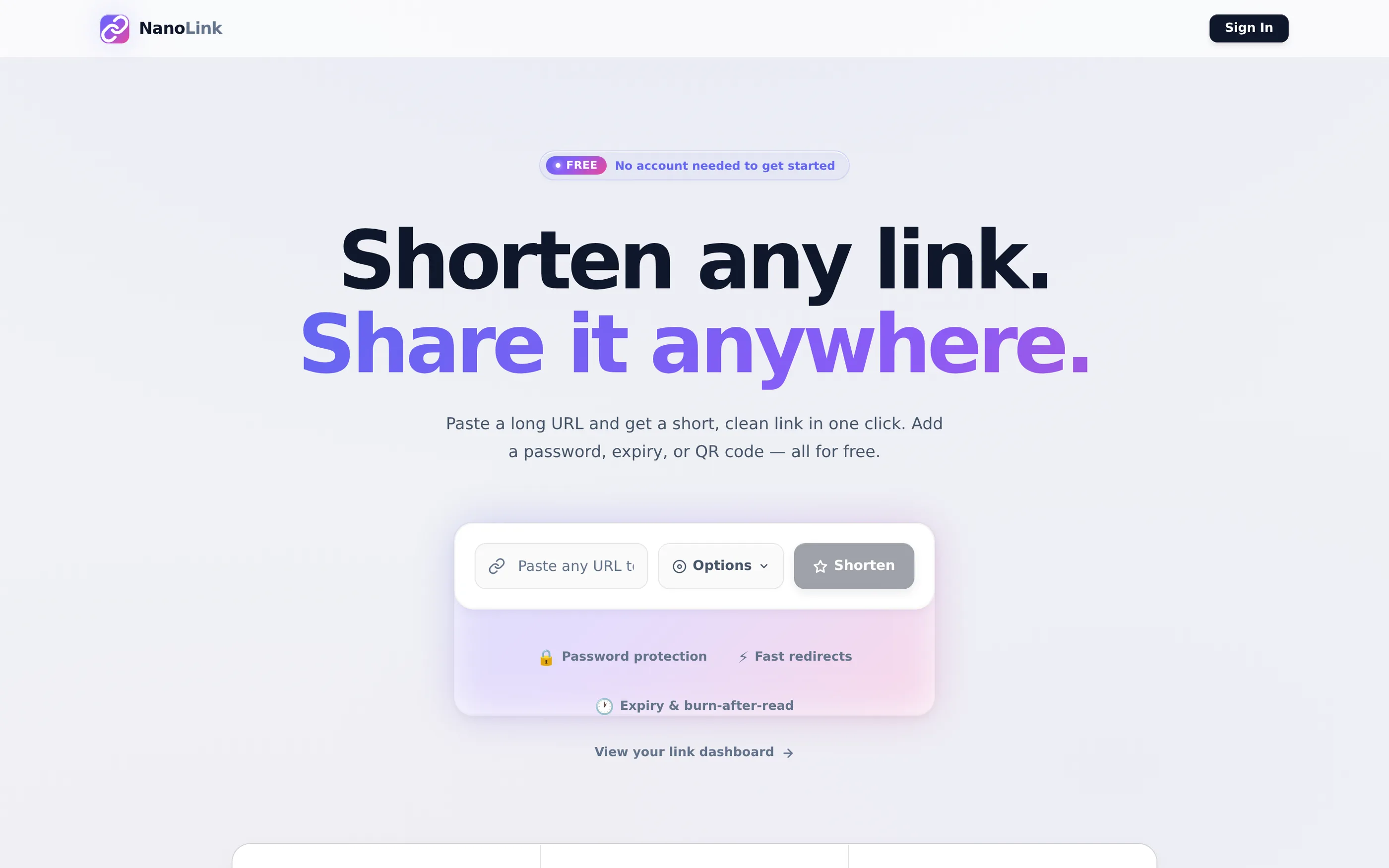
Inside NanoLink: from validated input to a saved link.

POST/api/links201 Created
src/app/api/links/route.tsTypeScript
const createLinkSchema = z.object({
  originalUrl: z.string().min(1, 'URL is required'),
  customAlias: z.string().optional().or(z.literal('')),
  password: z.string().optional().or(z.literal('')),
  expiresAt: z.string().optional().or(z.literal('')),
  oneTimeUse: z.boolean().default(false),
})
Source excerpt · NanoLink request validation
Read the route
  1. Next.js · Zod

    Request

    Read the JSON body and validate it with the Zod schema.

  2. TypeScript · nanoid · bcrypt

    Application logic

    Normalize the URL, check alias uniqueness and hash an optional password.

  3. Prisma · PostgreSQL

    Persistence

    Save the destination and options in the Link model.

  4. REST API

    Response

    Return the created record with HTTP 201.

03 / Selected work

Selected Engineering Work(Selected Systems · 50+ Shipped)

50+Products Shipped

50+ software products & systems shipped across remote teams & independent client builds · featured architectures with full open source below.

Across remote team collaboration, client contracts, and independent builds, I have shipped 50+ software products and systems. The projects below are the five publicly documented examples I use to show how I approach engineering, architecture, and production delivery.

01 / Business applicationsLive project
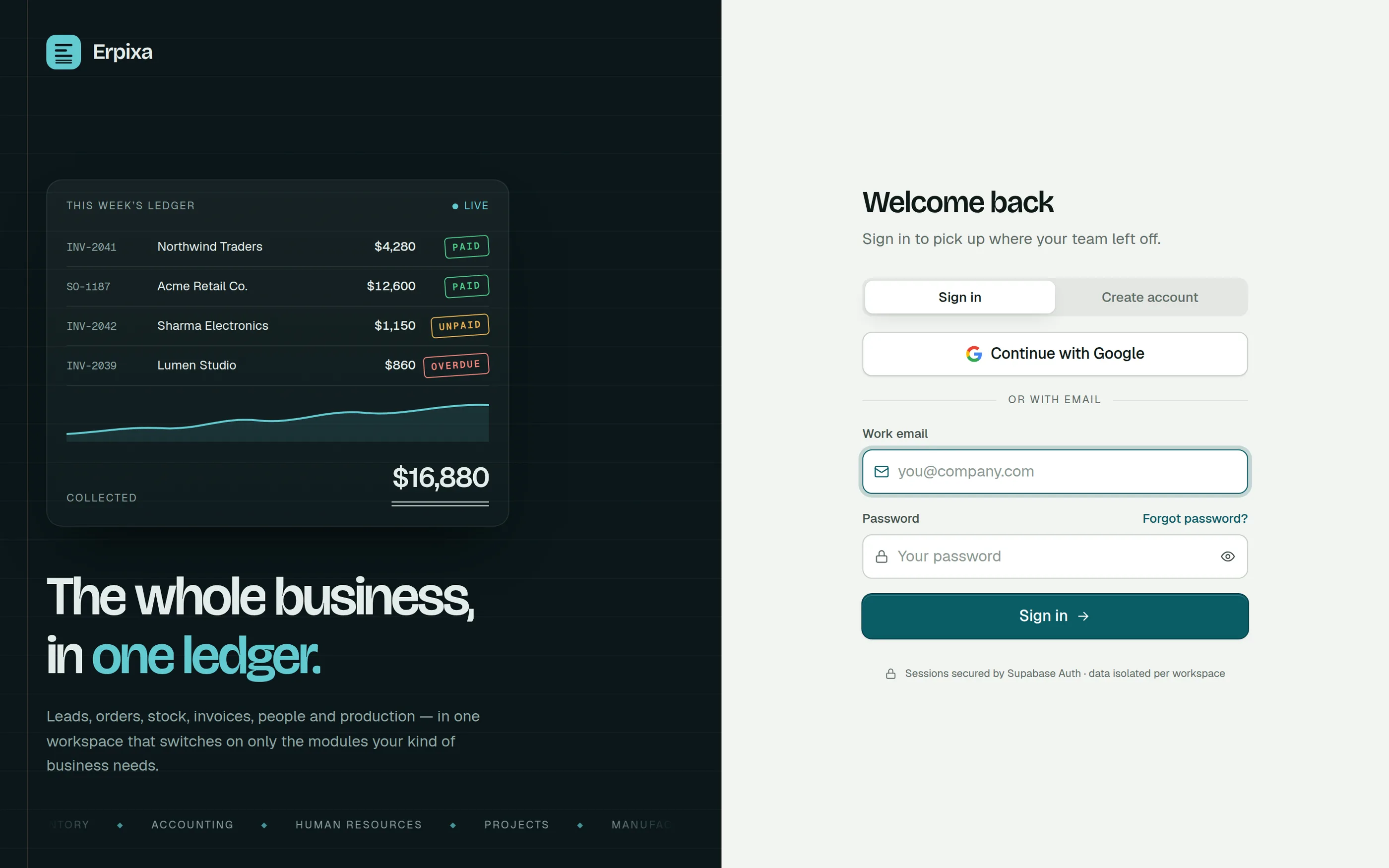
erpixa.vercel.app
Live
Erpixa real application interface from the deployed site
Production interfaceInspect architecture

Erpixa project details

Multi-tenant business management application with organization-based access, modular workflows, and database-level security policies.

  • React
  • TypeScript
  • PostgreSQL
  • Vite
01 · What It Is

Multi-tenant business management application with organization-based access, modular workflows, and database-level security policies.

02 · Problem

Small businesses struggle with disconnected departmental workflows, fragmented operational records, and lack of database-enforced multi-tenant data isolation.

03 · Engineering

Modeled multi-tenant organization boundaries, defined member role-based access control (RBAC), and built the application using React, TypeScript, and PostgreSQL with database-enforced Row-Level Security.

04 · Technical Evidence

PostgreSQL schema with Row-Level Security (RLS) policies for org-level isolation, membership foreign keys, modular React interface, and type-safe Vite architecture.

05 · Result

Organization membership and PostgreSQL row-level security policies restrict access to tenant records.

Architecture flow
  1. User Auth
  2. Organization Boundary
  3. Role Permissions
  4. Business Module
  5. PostgreSQL (RLS)
03 / Customer and payment workflowsLive project
telepoint-topaz.vercel.app
Live
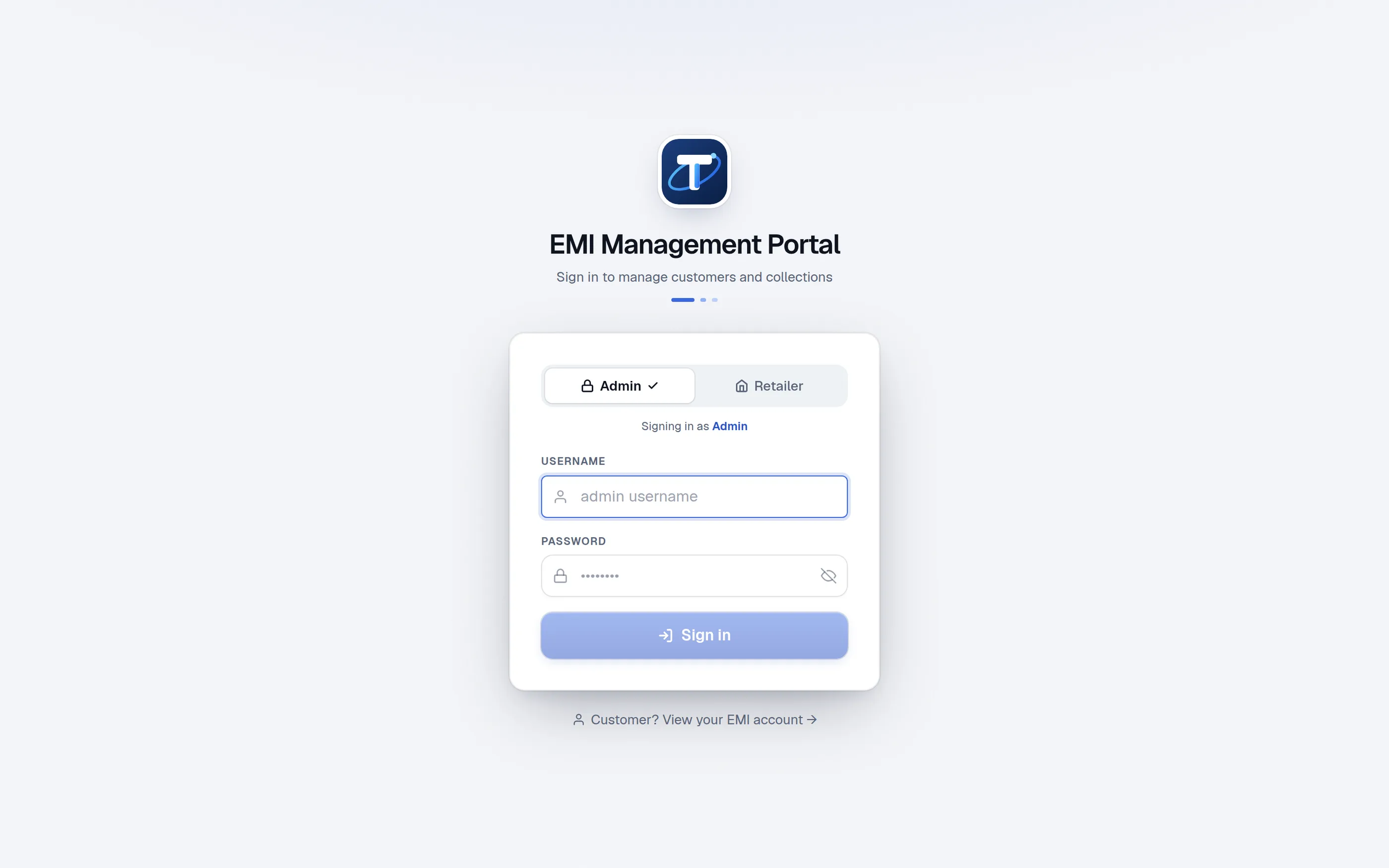
TelePoint EMI Management Portal sign-in screen from the deployed application
Production interfaceInspect architecture

TelePoint project details

EMI and customer payment workflow platform built to eliminate payment leakage and manual reconciliation in retail device financing.

  • Next.js
  • TypeScript
  • PostgreSQL
01 · What It Is

EMI and customer payment workflow platform built to eliminate payment leakage and manual reconciliation in retail device financing.

02 · Problem

Offline device retailers face payment disputes, cash reconciliation delays, and customer account leakage when tracking installment payments manually.

03 · Engineering

Modeled retailer-to-customer debt cycles, designed the verification state machine, and implemented customer ownership validation in Next.js and PostgreSQL.

04 · Technical Evidence

POST /api/payments/submit route validating retailer session, cross-referencing customer ownership, and enforcing installment status integrity.

05 · Result

Customer-to-retailer ownership checks authorize payment collection requests.

Architecture flow
  1. Authentication
  2. Retailer Boundary
  3. Customer Ownership
  4. Installment Check
  5. Payment Record
  6. Reporting
04 / Web · Windows · AndroidLive project
nexora-xi-rust.vercel.app
Live
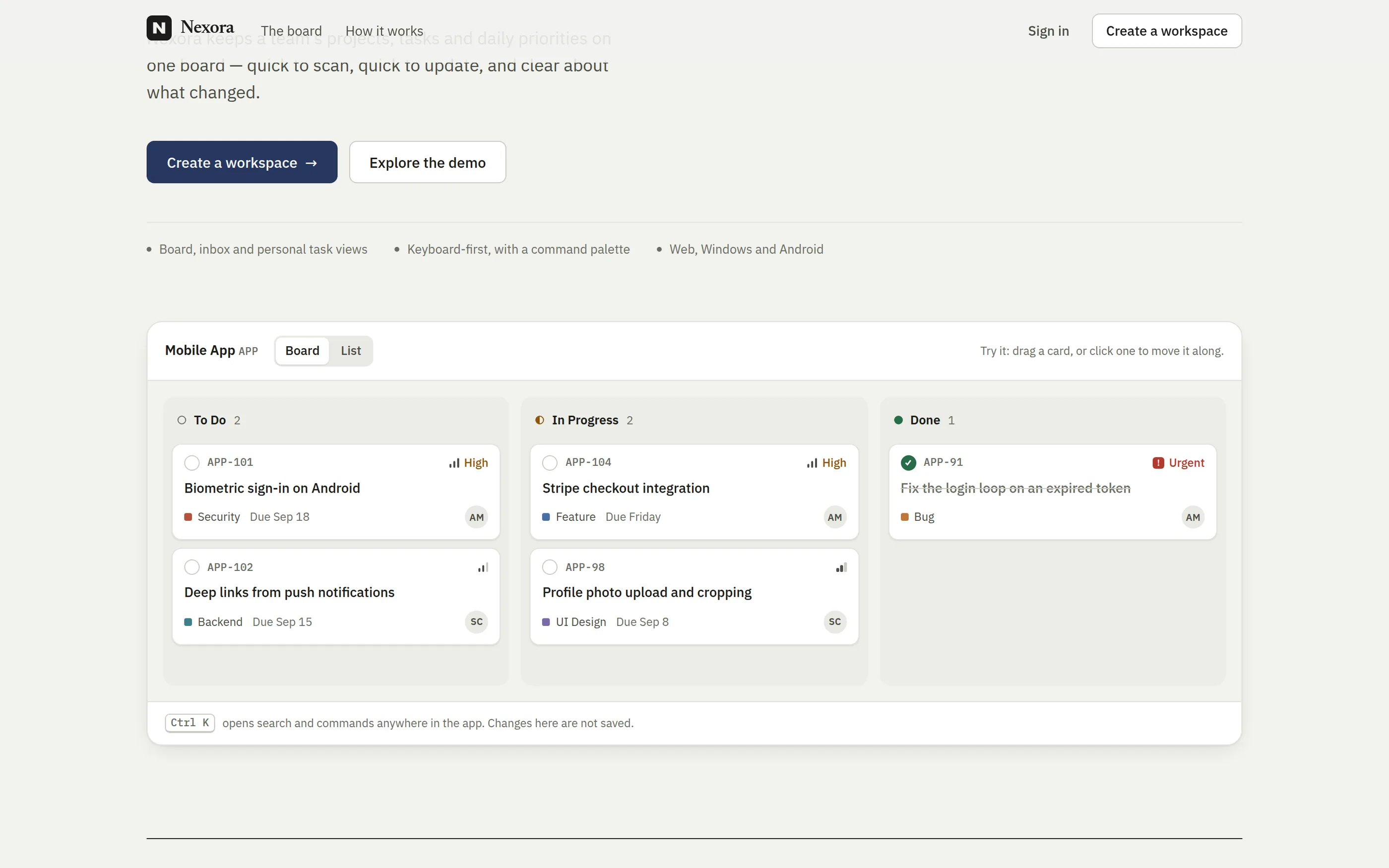
Nexora real application interface from the deployed site
Flagship cross-platform workspaceInspect architecture

Nexora project details

Cross-platform project and task management workspace running across Web, Windows desktop, and Android from a single TypeScript core.

  • Next.js
  • TypeScript
  • React
  • Electron
  • Capacitor
01 · What It Is

Cross-platform project and task management workspace running across Web, Windows desktop, and Android from a single TypeScript core.

02 · Problem

Knowledge workers juggle disconnected tools across desktop, web, and mobile, suffering from context switching and desynchronized project state.

03 · Engineering

Architected a shared TypeScript core and state machine, unifying board and list interfaces across Next.js (web), Electron (Windows), and Capacitor (Android).

04 · Technical Evidence

Unified TypeScript workspace state machine, keyboard command palette navigation, Prisma task mutations, and multi-platform build scripts.

05 · Result

Shared application code supports Web, Windows desktop and Android builds.

Architecture flow
  1. Shared TypeScript
  2. Web / Windows / Android
  3. Board & Task State
  4. Cross-Platform Sync
05 / Expenses and settlementsLive project
tripmate.boats
Live
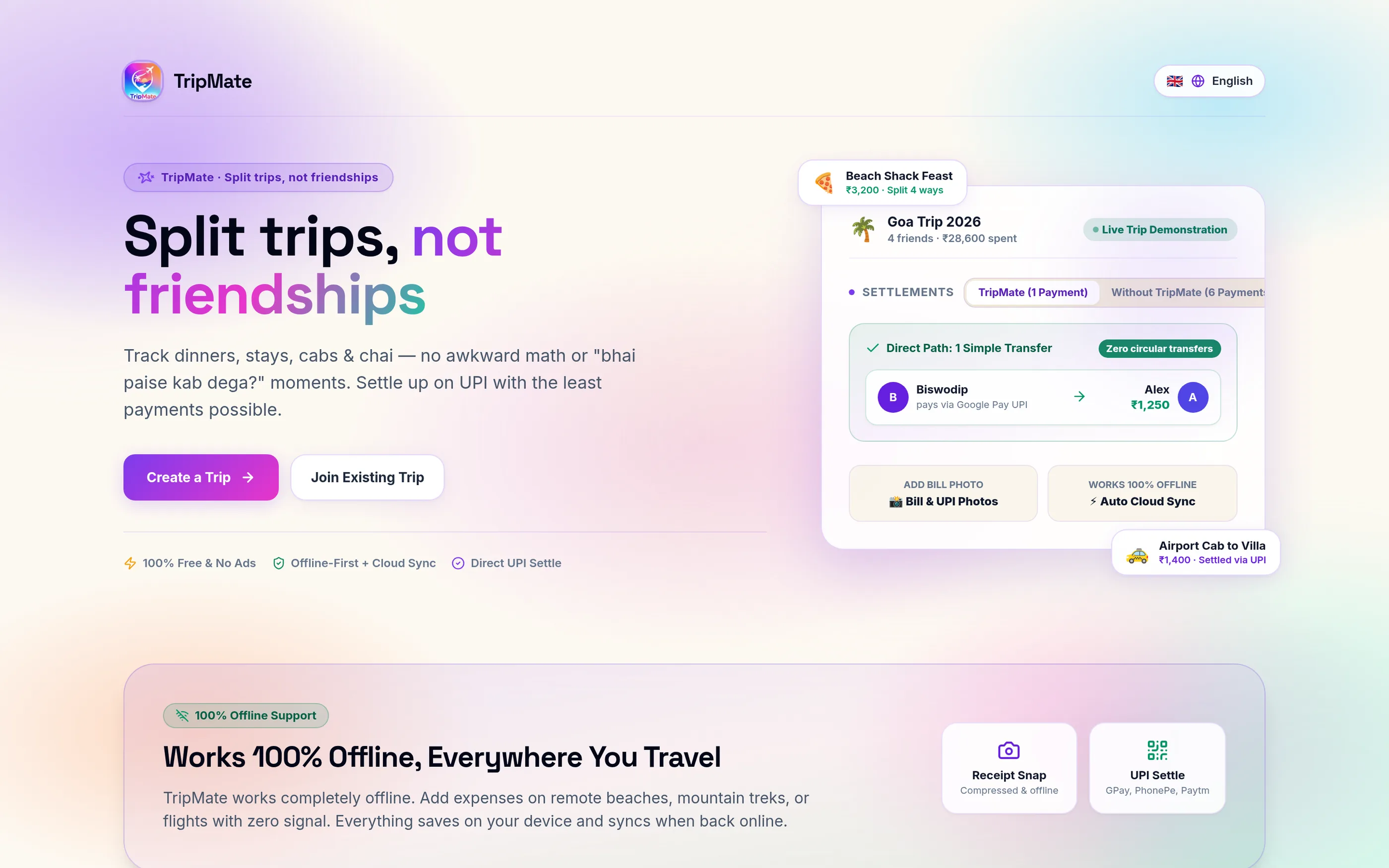
Tripmate real application interface from the deployed site
Production interfaceInspect architecture

Tripmate project details

Group expense and settlement application that simplifies multi-payer debts into minimal cash transfers with direct UPI payment links.

  • Next.js
  • React
  • TypeScript
01 · What It Is

Group expense and settlement application that simplifies multi-payer debts into minimal cash transfers with direct UPI payment links.

02 · Problem

Group travelers struggle with complex multi-payer expenses, uneven currency splits, and awkward manual debt reconciliation.

03 · Engineering

Implemented a greedy balance resolution graph algorithm in TypeScript, multi-party expense splitting logic, UPI deep links, and PDF summary exports.

04 · Technical Evidence

Minimized-debt greedy balance resolution algorithm (settleGreedy), relational balance mapping, and client-side PDF export generation.

05 · Result

Minimizes total required cash transactions across participants using a greedy debt-simplification algorithm.

Architecture flow
  1. Expense
  2. Participants
  3. Balance Calculation
  4. Settlement Algorithm
  5. UPI / PDF Export

04 / How I Engineer

How I engineer software

I bridge business analysis and full-stack software engineering, from requirements and data schemas to user-facing applications.

From Requirement to Production

Turning real operational workflows into deployed, working software.

  1. Requirement
  2. Workflow
  3. Data Model
  4. API
  5. Interface
  6. Validation
  7. Testing
  8. Deployment
  9. Iteration
  1. Requirements → Workflows → Constraints

    Understand

    Elicit real operational friction, analyze user workflows, define system boundaries, and establish unambiguous acceptance criteria before writing code.

    Verification: Business specifications & stakeholder workflow maps.
  2. Data → Domain → Permissions → Contracts

    Model

    Design relational schemas with foreign key integrity, define organization boundaries, specify API contracts, and establish database-level security policies.

    Verification: PostgreSQL relational schemas & Zod boundary contracts.
  3. Interface → Application Logic → APIs → Database

    Build

    Implement type-safe React/Next.js interfaces, REST endpoints, authentication, and persistent database transactions.

    Verification: Shipped TypeScript, Next.js, and PostgreSQL codebases.
  4. Tests → Edge Cases → Workflow Validation → Debug

    Verify

    Exercise end-to-end user workflows, test boundary conditions, reproduce edge cases, and run automated CI verification suites.

    Verification: Playwright browser tests, API tests, and CI pipelines.
  5. CI → Deployment → Production Iteration

    Ship

    Deploy to production environments, configure multi-stage container builds, monitor live applications, and iterate based on real feedback.

    Verification: Live deployed applications & GitHub repositories.

Demonstrated Competency

Engineering Evidence

The parts of software development I repeatedly handle across real builds.

01

Requirements → System Design

Turning unclear stakeholder needs into concrete data boundaries and clear system rules.

  • Requirement analysis & functional specifications
  • Domain workflow modeling & state machines
  • Business-rule elicitation & edge-case mapping
  • Acceptance criteria & user verification stories
  • System boundary definition & contract modeling
02

Data & Backend

Designing relational schemas, data layers, and RESTful APIs.

  • Relational schema design (PostgreSQL)
  • Prisma ORM & SQL data modeling
  • Type-safe REST API route architecture
  • Authentication & token session management
  • Runtime request validation & ACID persistence
03

Frontend Engineering

Developing responsive, accessible web interfaces with clean component structure and predictable state.

  • React & Next.js App Router applications
  • Strict TypeScript component boundaries
  • Application state management & optimistic UI
  • Responsive design & fluid layout systems
  • Accessible markup & zero-shift interaction
04

Security & Access Control

Enforcing access policies at both the API perimeter and directly within the database engine.

  • Role-Based Access Control (RBAC)
  • PostgreSQL Row-Level Security (RLS)
  • Strict runtime input validation (Zod)
  • Account & customer ownership validation
  • Protected API routes & multi-tenant isolation
05

Quality & Verification

Checking complete user journeys with repeatable tests and careful debugging.

  • API route testing & payload validation
  • Critical user journey & workflow testing
  • Boundary condition & regression checks
  • Systematic defect reproduction & tracing
  • Browser automation testing (Playwright)
06

Delivery & Production

Shipping software reliably with container builds, continuous integration gates, and managed releases.

  • Git branch workflow & semantic commit hygiene
  • GitHub Actions automated CI verification
  • Multi-stage Docker containerization
  • Production deployment (Vercel & cloud)
  • Post-release monitoring & defect triage

Technical Trade-Offs

Engineering Decisions

Real architectural choices, trade-offs, and technical justifications from shipped projects.

ErpixaMulti-Tenant Business Management Application

Why Database-Level Access Control (RLS)?

Relying exclusively on application-layer WHERE filters risks cross-tenant leaks if a developer misses a tenant_id parameter in any query. PostgreSQL Row-Level Security guarantees isolation at the database engine level, enforcing organization separation across every query and role automatically.

NanoLinkProduction-Style URL Management Service

Why Runtime Boundary Validation (Zod)?

Client-supplied parameters, aliases, passwords, and expiration dates must be verified before reaching application logic. Strict Zod schemas sanitize input at the API entry point, preventing malformed records, type mismatches, and unhandled Prisma database exceptions.

TelePointEMI & Payment Collection Workflow Platform

Why Retailer-to-Customer Ownership Validation?

Offline device financing involves multiple retailer accounts. Comparing customer ownership against the authenticated retailer before processing installment collections prevents unauthorized debt collection, duplicate submissions, and ledger reconciliation disputes.

NexoraCross-Platform Project & Task Workspace

Why Shared TypeScript Architecture?

Maintaining separate codebases across Web, Windows (Electron), and Android (Capacitor) causes feature drift and triples maintenance costs. A shared TypeScript core unifies board state machines, keyboard navigation, and schemas across all three targets with zero divergence.

Tripmate & TelePointExpense Split & Installment Calculations

Why Relational Data Modeling for Financial Flows?

Multi-party balances, installments, and payment records require strict foreign key constraints, ACID transaction guarantees, and exact calculations that document stores cannot reliably guarantee without custom distributed locking.

Principles I engineer by.

Start with the business workflow.
Software succeeds when it mirrors the real-world operational rules and domain relationships.
Use the right data model.
Structure data around the actual relationships and workflows the application needs.
Validate at the boundary.
Treat user input, API requests and external data as untrusted until they have been checked.
Make behaviour easy to verify.
Clear logic, useful tests and reproducible bugs make software easier to maintain.

05 / Education & Background

The foundations behind the frameworks.

My formal CS background gives me a foundation in the principles behind software development, not only the frameworks used to build applications.

2021–2024

B.Tech in Computer Science & Engineering (B.Tech CSE)

Brainware University, Kolkata

2018–2021

Diploma in Computer Science & Engineering (Diploma CSE)

Brainware University, Kolkata

  1. 2018–2021

    Diploma in Computer Science & Engineering

    Built the fundamentals of programming, data structures, relational databases, networking and operating systems at Brainware University, Kolkata.

  2. 2021–2024

    B.Tech in Computer Science & Engineering

    Graduated with core foundations in software engineering, algorithms, database systems and distributed application design at Brainware University, Kolkata.

  3. 2024

    Shipped Full-Stack Applications

    Engineered and shipped 5 production web applications (NanoLink, TelePoint, Erpixa, Nexora, Tripmate) handling real database migrations, authentication and multi-tenant security.

  4. 2024–Now

    Full-Stack & AI Systems Engineering

    Delivering full-stack products for clients and remote teams, plus LLM work: QLoRA fine-tuning and FastAPI model serving for a client support assistant.

Computer Science Foundations

  • Data Structures & Algorithms
  • Object-Oriented Programming
  • Database Management Systems
  • Operating Systems
  • Computer Networks
  • Software Engineering
  • Cyber Security
  • Distributed Applications

06 / Credentials & Résumé

The experience behind the work.

Full-Stack Software Engineer (B.Tech Computer Science, 2024) building production web applications with React, Next.js, Node.js, TypeScript and PostgreSQL. Owns delivery end to end: requirements, REST API and database design, secure multi-tenant access control, automated testing, CI/CD and deployment. 50+ projects shipped for client companies and remote teams, including a live fintech EMI/payment platform, a multi-tenant SaaS ERP and a fine-tuned LLM for a client support assistant.

Professional experience

  1. 2024–Present

    Full-Stack Software Engineer

    Freelance / Contract — client companies, startups and remote teams

    • Delivered multi-tenant SaaS, fintech/payment and productivity apps end to end: requirements, data model, REST API, React UI, tests, release.
    • Designed PostgreSQL schemas and Node.js/Next.js REST APIs with tenant isolation enforced in the database through Row-Level Security.
    • Fixed production payment defects: an approval API returning invalid JSON intermittently and triggers that could double-apply payments.
    • Fine-tuned Qwen2.5-3B-Instruct with QLoRA and served it through a FastAPI endpoint for a client's customer-support assistant.
    • Protected releases with Vitest and Playwright suites in GitHub Actions CI/CD covering access control and core business rules.
  2. Sep 2023–Nov 2023

    Software Engineering Trainee (Industrial Training)

    Logicrack Infosystem Pvt. Ltd.

    • Built Office CRM, a customer and workflow management app, in C# / ASP.NET Core 6.0 MVC during a 10-week certified programme.
    • Designed the relational schema, controllers, domain models and Razor views.
  3. 2022

    Web Development Trainee

    Webguru Technology

    • Built responsive web interfaces and learned client-server fundamentals and UI component integration.

Education

  • B.Tech in Computer Science & Engineering (B.Tech CSE)Brainware University, Kolkata · 2021–2024
  • Diploma in Computer Science & Engineering (Diploma CSE)Brainware University, Kolkata · 2018–2021
  • Secondary & Higher Secondary EducationUluberia High School · 2011–2018
Technical skills (Expand breakdown)
LANGUAGES

TypeScript · JavaScript (ES6+) · SQL · Python · C# · HTML5 · CSS3

FRONTEND

React · Next.js (App Router, Server Components) · Tailwind CSS · Zustand · React Hook Form · Vite · Electron (Windows) · Capacitor (Android)

BACKEND & APIS

Node.js · REST API design · Next.js Route Handlers · Zod validation · Authentication & authorization · FastAPI · ASP.NET Core MVC

DATABASES

PostgreSQL · Data modelling · Row-Level Security (RLS) · Migrations & triggers · Indexing · Prisma ORM · Redis

CLOUD & DEVOPS

Docker · Kubernetes · CI/CD with GitHub Actions · AWS S3 · Vercel · Linux · Git & GitHub

TESTING & SECURITY

Unit testing (Vitest) · End-to-end testing (Playwright) · Role-based access control (RBAC) · OAuth 2.0 · bcrypt · Multi-tenant isolation

AI / ML

LLM fine-tuning (QLoRA) · Model serving (FastAPI) · RAG · Prompt engineering